A sourced, cinematic Solar System
Helios
Helios connects planetary science to human scale: your weight on Mars, the length of a day on Venus, or the time sunlight needs to reach Neptune.
- Real bodies
- 57
- Context regions
- 4
- Detail destinations
- 61
- Visual system
- Consistent visual profile
Product position
Scale, place and evidence stay connected
Explore without pretending
Readable body sizes and compressed distances are labelled as a presentation choice. Scientific view uses a shared physical ratio without claiming navigation-grade simulation everywhere.
Translate numbers into experience
Gravity, day length, sunlight delay and atmospheric reference levels are framed around questions a visitor can understand without hiding the definition behind each number.
Keep data time visible
Reference, historical, latest-available and near-live records keep different labels. Remote failure cannot turn an old observation into a fake current state.
Four ways in
Choose a question, not a menu category
Every body page follows the same sourcing and accessibility standards, while its editorial structure changes with the world. These four entries show that range without reducing the library to a grid of identical cards.
- 01
Sun
Start at the source
Read the star as a physical reference: radius, rotation, illumination and the visual limits of a cinematic corona.
Open destination → - 02
Earth
Keep the baseline visible
Earth anchors every human-scale comparison while near-live and historical records remain clearly separated from reference facts.
Open destination → - 03
Mars
Familiar time, hostile conditions
A near-Earth day length meets a thin atmosphere, dated mission evidence and a gravity comparison that never changes mass into a gimmick.
Open destination → - 04
Saturn
See a system, not an icon
Rings, atmosphere and moons are treated as one planetary architecture with scale and reference-level caveats kept in view.
Open destination →
Dated media record
A window beyond the planetary catalogue
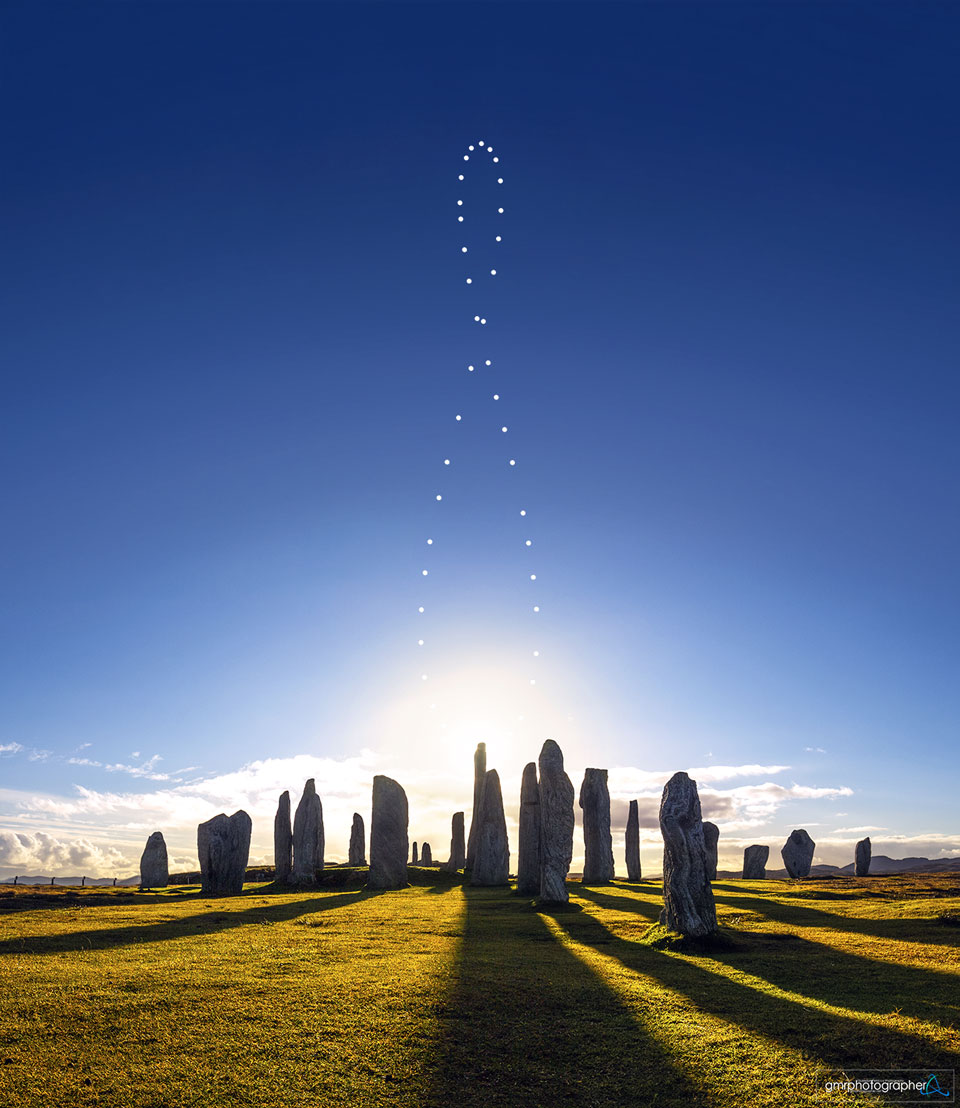
APOD supports the Helios story without replacing it. The record keeps its date, media type, credit and official source. When remote media is unavailable, the dated record remains readable.
 Image
ImageAstronomy Picture of the Day
Analemma over the Callanish Stones
If you went outside at the same time every day and took a picture that included the Sun, how would the Sun's position change? A visual answer to that question is an analemma, a composite image taken from the same spot at the same…
Copyright: Giuseppe Petricca
Service v1
Continue with context
The scene is only one layer of the product
Browse the body library, compare worlds with an accessible table, follow the mission record, or see how Helios handles sources, unavailable data and visual interpretation.