World 05 · gas giant
Jupiter
A storm-bound giant with no solid ground.
Jupiter is the largest planet, a hydrogen-helium giant whose visible bands and storms sit above progressively denser fluid layers.
Editorial atmospheric bands. The visible edge is a cloud system, not solid ground.
- Order from Sun
- 5
- World type
- Gas giant
Mean radius
69,911km
142,984 km equatorial diameter
Solar day
9h 54m
Prograde rotation
Temperature reference
-110°C
Atmospheric reference level, not a surface
Reference signals
The conditions that define this world
A deep hydrogen-helium atmosphere with ammonia and water clouds.
Gravity
Powerful, but defined without a surface
The reference gravity is more than twice Earth's. Its definition matters because Jupiter's atmosphere has no fixed ground boundary.
Moons
A planetary system inside the Solar System
The dated catalog includes more than one hundred recognized moons, with Io, Europa, Ganymede and Callisto forming the prominent Galilean group.
Rings
A faint dusty system
Jupiter has rings, but they are thin and subdued rather than the dominant architecture seen around Saturn.
- Axial tilt
- 3°
- Recognized moons
- 115 · 2026-07-17
- Rings
- Jupiter has a faint dusty ring system.
- Atmosphere
- hydrogen · helium · methane · ammonia
Scale without ground
A planet defined by depth
Jupiter's visible bands are the top of a deep atmosphere. Moving downward does not lead to a walkable surface; pressure and density increase through fluid layers.
Layers
Cloud tops are not a surface
Helios uses a one-bar reference level for gravity and temperature because Jupiter has no solid surface comparable with Earth's ground.
The familiar circular outline is a visual boundary in the clouds, while the planet continues inward through increasingly dense hydrogen-rich material.
Tempo
The largest planet turns in under ten hours
Jupiter combines enormous size with a short day. Rapid rotation shapes its banded atmosphere and contributes to an equatorial bulge.
Its year is long by human standards, but the daily rhythm is faster than on any terrestrial planet.
Personal comparison
Put the numbers against your own body
Gravity, day length and sunlight delay become more understandable when related to an Earth reference.
Your Earth reference
A scale comparison at a defined pressure level
The gravity calculation uses Jupiter's one-bar reference level. It is a comparison convention, not a promise that a person could stand there.
Use a value from 0 to 1,000 kilograms.
Jupiter scale equivalent
—kg
This is an Earth-style scale equivalent. Your mass does not change, and a giant-planet value refers to a defined atmospheric level rather than a place to stand.
Exploration record
How we learned to read this planet
Mission summaries are tied to dated official records and are not presented as live telemetry.
- 01
Jupiter orbiter
Juno
Juno probes beneath Jupiter's clouds to study its origin, interior, magnetic field, atmosphere and polar storms.
Scientific limits
What these values do—and do not—describe
Reference values keep their definition, source and date context. Editorial diagrams are separated from measured planetary data.
Sources and provenance
- NASA Jet Propulsion LaboratoryPlanetary Physical Parameters ReferenceAccessed Jul 17, 2026
- NASA Jet Propulsion LaboratoryApproximate Positions of the Planets ReferenceAccessed Jul 17, 2026
- NASA SciencePlanet Sizes and Locations in Our Solar System ReferenceAccessed Jul 17, 2026
- NASA ScienceTemperatures Across Our Solar System ReferenceAccessed Jul 17, 2026
- NASA ScienceJupiter Facts ReferenceAccessed Jul 17, 2026
- NASA Jet Propulsion LaboratoryPlanetary Satellite Discovery Circumstances Latest availableAccessed Jul 17, 2026
- NASA ScienceJuno Latest availableAccessed Jul 18, 2026
NASA mission media
Jupiter, through a mission archive
Every preview comes from the reviewed NASA media list for that world. A failed request can only fall back to media curated for Jupiter.
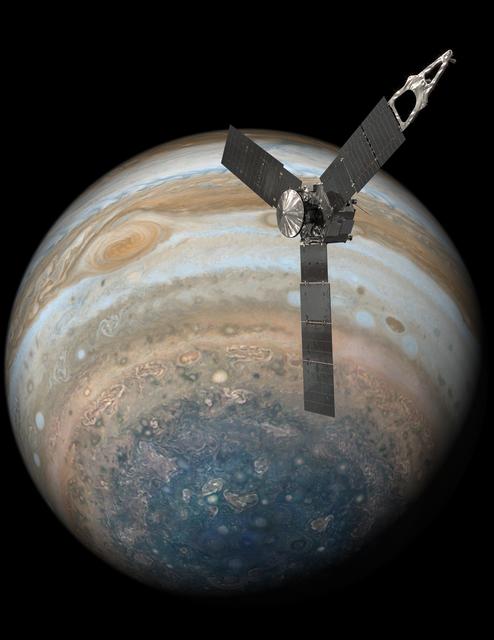
Juno Over Jupiter's South Pole (Illustration)
This illustration depicts NASA's Juno spacecraft soaring over Jupiter's south pole. https://photojournal.jpl.nasa.gov/catalog/PIA21771
NASA/JPL-CaltechNASA media details
Juno Images Jupiter's Dark Side
Juno's Radiation Monitoring Investigation used the Stellar Reference Unit (SRU) star camera to collect this high-resolution image of the dark side of Jupiter during Perijove 11 on…
NASA/JPL-Caltech/SwRINASA media details
Juno's SRU Captures Jupiter Lightning
Juno's Radiation Monitoring Investigation used the Stellar Reference Unit (SRU) star camera to collect this high-resolution image Jupiter's northern auroral oval on May 24, 2018…
NASA/JPL-Caltech/SwRINASA media details